Mustard – I don’t like the taste of it, the smell of it, the look of it, the texture of it, the colour of it. It grosses me out to the max. As a matter of fact, my aversion to the condiment began inside the womb, for my mother’s cells loathe mustard as well.
My children, who are at the sweet young ages of five and seven, decide to play a prank on their old man.
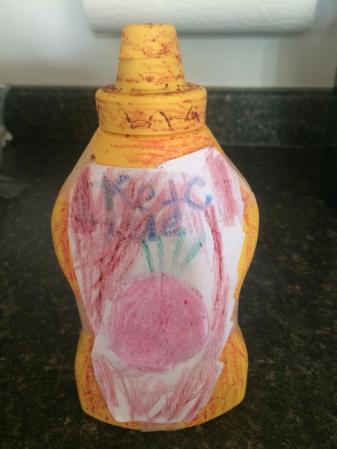
They take a bottle of mustard and disguise it using their red crayons.
Mustard bottle disguised as ketchup. Photo by B. Fleming
“Hey Dad, we got this new kind of ketchup to try. It’s really good. I think you’ll like it.”
“Um…okay. I’ll try it on my burger.” I cringe at the site of the yellow stream on my hamburger.
“Ah, kids, it kinda looks like mustard to me.”
“Dad, it’s actually ketchup. It’s made from yellow tomatoes. Try it. It’s really good.”
I take a small bite. My senses cry foul at the pungent yellow nastiness. I spit out the mustarded burger in disgust, and my kids laugh and laugh.
Days later, I come home from work.
“Hey Dad, we got you a present today.”
They hand me a mustard shirt. And they laugh and laugh.
As a learning skills specialist, I am acutely aware of the importance of continual feedback in the learning process. In Learn Better, Ulrich Boser writes:
The best feedback mixes an observation with a structured way to produce the proper outcome.
Never did this idea become more obvious than when I was watching my 5-year-old son’s swimming lesson the other day. My son is in the process of learning the front crawl. During the lesson, his instructor would have him do a lap of the pool. Then she would point out something that could be done to improve my son’s technique. She used a variety of methods—demonstration, analogy, or hands-on—to show a specific aspect of the skill.
My son would listen attentively and sure enough, when he did his next lap of the pool, his technique improved. Once again, the instructor would provide feedback and guidance, focusing on a single technical component of the stroke. And on it went: lap, feedback, lap, feedback. I observed a marked difference in my son’s mechanics as the lesson progressed.
Whether it’s learning a new skill such as swimming when you’re five, driving a car when you’re a teenager, or conversing more diplomatically when you’re an adult, the value of feedback should not be overlooked. It is essential for mastering any skill.
I learned a long time ago that for my wife, lavish gifts on special occasions are not as important as sentimental cards.
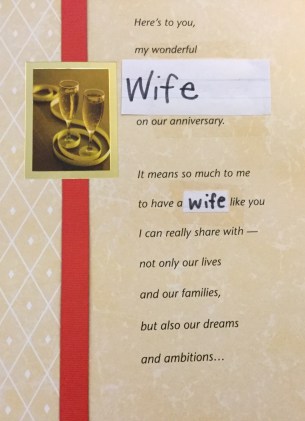
So this year for our wedding anniversary, I made sure to get a card. But the store I went to didn’t have the greatest selection. I did, however, find a good anniversary card that said, “To my husband…” I purchased the card and with a little creativity, I was able to make it work. In places where the word “husband” appeared, I taped small pieces of paper and wrote “wife.” Below is a picture of my masterpiece.
One afternoon, my daughter and her friend decided to climb a large maple tree in our front yard. The first large branch is only a few feet off the ground and easy to get to for a kid who’s climbed a couple trees before. The problem, however, was that my daughter had no experience climbing trees. She couldn’t get up on that first branch that’s only a few feet off the ground. She tried a few times with no success. Her initial frustration quickly escalated to catastrophic heights.
As she stormed away from the maple and into the house, she screamed, “I suck at climbing trees! I’ll never be able to climb a tree in my life! I’m a loser!” Then the tears came.
I waited a moment before I followed her into the house.
I found her face down on the couch. I rubbed her back and said, “Listen. Climbing a tree is hard. It takes lots of practice. If climbing a tree is something you want to be able to do, we can work on it. You can’t do it yet. Remember, you couldn’t ride your bike at first, but now you’re really good. You are good at lots of things. You are definitely not a loser.”
Over the next few days, I found my daughter under the maple tree trying different ways to pull herself up onto that first branch. And the look on her face when she finally did was priceless.
Thank you for guiding me. You made a difference in my life. And I will miss you.
You said a quiet mind is not a precursor to peace. Your mind keeps going, but you can recognize that you don’t have to get involved with it. Don’t involve yourself. We constantly try to resist everything. This is the mind, you said. Don’t be involved with this resistance, and you will be at peace. Soften...Experience… Create a distance between you and your thoughts. Don’t engage. The mind comes up with many things. Don’t fight your mind. When you don’t engage, the troubling thought is gone. It’s kinda like bubbly bubbly Eno. Don’t identify with your thoughts, your personality. You’ll ask, who is this? But this is not conceptual, you said. This is a feeling, a sense. You will discover a power within yourself so nothing empowers you. With this new power, this new awareness, your general way of being will be at peace.
Thank you for guiding me. You made a difference in my life. And I will miss you.
Peace at 7:00 a.m. in a kayak on a summer morning. Just me, my daughter, and nature.
My serenity, however, is broken when I arrive home, for when I unload my kayak, I notice a couple small dents on the hull. I’m angry. How could I have let this happen?
“Man, I can’t believe it! Look at these dents.”
My seven-year-old daughter responds in a calm voice. “Daddy, it’s fine. I have a dent in my water bottle and it still works just fine.”
There is wisdom behind her words. Don’t let the imperfections, the nicks, the scratches, the dents, the depressions—whatever you call them—consume you. Things still work just fine.
I have come to discover that every student has the ability to grow and improve as a learner. By developing a relationship of trust, an environment is created such that students can express their challenges and what they’d like to improve on.
Real growth and development comes from an intrinsic desire to better oneself. A helper can only guide students when that fire is kindled with a supportive, non-judgmental relationship.


 Michael Fleming, MEd, MMT, OCT